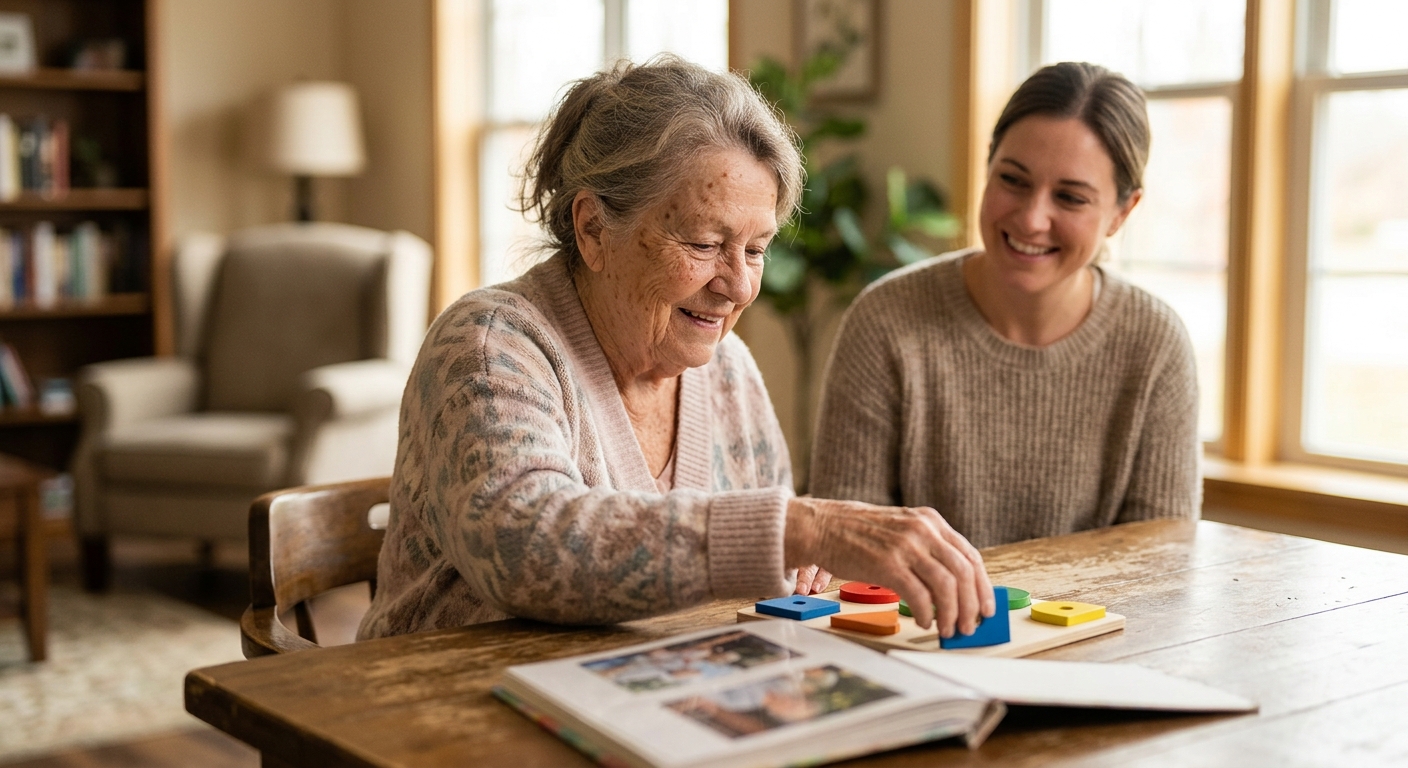
Memory Care Activities for Seniors with Dementia
Last October, I sat across from my friend Lisa at her kitchen table, watching as she struggled to coax her mother, June, into joining us for a simple puzzle. June, once a vivacious teacher, had been slipping further into the fog of dementia. Lisa looked at me with tears welling up, asking a question I’ve heard dozens of times in my career: “Is there anything I can do that really helps her feel engaged?”
I’ve walked this road alongside dozens of families, each trying to keep their loved ones connected to life and memories, hoping that just a little bit of joy or comfort might break through. More families than ever are confronting this challenge. In fact, according to the Alzheimer’s Association, nearly 7 million Americans are living with Alzheimer’s in 2024. That number is climbing rapidly. The need for meaningful memory care activities is no small thing, it’s a lifeline for both those living with dementia and the families who love them.
So, why does this matter so deeply? Because the right dementia activities are about more than passing time. They provide dignity, spark moments of clarity, and can trigger genuine happiness. I’ve seen a 92-year-old light up when hearing a favorite song from her youth, or a couple holding hands after painting side by side. In memory care, it’s these moments, however small, that remind us of the person still there, beneath the confusion. That’s why I believe so strongly in thoughtful Alzheimer’s activities, not as busywork, but as a way to reach the heart.
Understanding the Heart of Memory Care
Pull back for a moment and consider what we’re really seeking when we look for dementia activities. At our core, we all want to feel connected, valued, part of something. Dementia steals steadily, names, faces, abilities, but it cannot erase our need for connection.
I remember working with a gentleman named Saul, an engineer by trade, who was restless and withdrawn in his memory care community. Staff tried to involve him in group games and crafts, but nothing seemed to stick, until we realized what made him tick. I suggested bringing out simple circuit kits, something he could tinker with and which still felt familiar. Saul’s whole demeanor changed. Here’s the thing: picking the right activities isn’t about what’s “for dementia” in general, but what’s right for *your* loved one, what feels familiar, meaningful, and achievable for them.
There’s robust evidence to support this approach. A 2024 study from Johns Hopkins found that personalized memory care activities lead to a 40% reduction in agitation and a 30% increase in overall well-being among dementia patients. Not just any activity will do, it must fit the person. What I recommend is starting with who they were, what they loved, and what skills remain, then building from there.
You may also want to read our article on how music therapy helps seniors.
Common Mistake to Avoid: Don’t assume all dementia activities are “one size fits all.” Cookie-cutter approaches can frustrate your loved one and set you up for disappointment. Instead, take time to recall their old hobbies, work, and preferences.
Pro Tip: Keep it simple and be willing to change course. Sometimes what worked last week won’t today, and that’s okay.
Sensory Activities: Reaching When Words Fail
Let me paint a picture: Ruth, a former pianist now rarely speaks, but when I placed a soft velvet cloth in her hand, she began to smile and rub her fingers over the texture. Her face brightened every time we repeated this simple activity. When language falters, our senses remain a powerful way in.
Sensory activities are easy to overlook, but in my experience, they’re often among the most successful forms of dementia activities. In fact, the Alzheimer’s Society in the UK reports that tactile stimulation can calm anxiety and lower agitation levels by up to 50%.
Here are a few sensory ideas that consistently work wonders:
- Soft objects, like a weighted blanket or a plush pillow. The Huggaroo Weighted Lap Pad ($39 on Amazon) is a favorite in memory care circles, offering both soothing weight and comforting texture.
- Aromatherapy: Scent is directly linked to memory. Try a diffuser with calming lavender oil ($16 for a starter set). Monitor for sensitivities, though, not all scents are comforting to every person.
- Simple art projects: Watercoloring or finger painting on smooth paper feels satisfying and lets creativity flow without pressure.
You might be wondering, “How do I know if a sensory activity is working?” Watch their reaction. A relaxed face, calm hands, or even laughter can be your signals. And if something fails, don’t force it. Move on and try again later.
Common Mistake to Avoid: Overstimulating the senses with too many textures, lights, or smells at once. Stick to one or two elements, and always test on yourself first if you’re unsure.
Pro Tip: Create a “sensory basket” with 4–5 different items so you can easily rotate and discover what soothes or delights your loved one on any particular day.
Music and Memory: Unlocking the Past
There’s a moment I’ll never forget: Madeleine, a former choir singer with mid-stage dementia, sat silently until her daughter played Louis Armstrong’s “What a Wonderful World.” Madeleine began humming, then softly sang along, tears streaming down her face. That one song unlocked weeks of memories.
Music truly is magic for those living with dementia. The 2023 Music and Memory Project found that familiar songs reduced depression scores by 35% and decreased disruptive behaviors significantly. That’s a game changer.
If you’re wondering where to start, let me share what has worked time and time again. More evidence-based strategies are available from the National Institute on Aging.
- Playlists of favorites: Ask family members about your loved one’s favorite artists. Build simple playlists on Spotify or Apple Music, monthly subscription around $10, but you can use free versions with ads.
- Sing-along sessions: Songbooks for seniors, such as “The Big Book of Nostalgia” ($18), are treasure troves for group activities or even one-on-one.
- Hand-held instruments: Small shakers or tambourines ($15-25 at local music stores) let even those with limited movement participate.
Don’t shy away from repetition. Many seniors with dementia love hearing the same few songs every day, it actually reinforces memory and provides comfort.
Common Mistake to Avoid: Choosing only “oldies” that you think are classic. Your loved one may have a unique musical taste, jazz, gospel, even show tunes from their era. Ask, don’t assume.
Pro Tip: Pair music with photos from the same era. I’ve seen remarkable moments where a person recognizes a photo *and* starts singing along with the music in the background. The combo is powerful.
Art, Crafts, and Creating Something Beautiful
Art often speaks when words do not. You don’t have to have a single artistic bone in your body to make this work. Truth be told, some of my favorite memory care moments involve laughter about silly drawings or hands messy with glue.
One thing I didn’t understand early on is how much my own mood sneaks into the room before I even say hello. I remember a rainy Tuesday—November 8, 2022—when I rushed into Brookside Memory Care after sitting in I‑5 traffic, jaw clenched, Starbucks already cold. I brought a whole “activity plan.” It flopped. Not because the plan was bad, but because I was loud in my body. When I finally slowed down, washed my hands, and sat beside Clara without an agenda, she reached for my sleeve like she’d been waiting. That’s when I started treating activities like invitations, not assignments.
Take Helen, for instance: once an avid gardener, she lost her ability to tend plants. So, we switched to making colorful paper flowers together. She was able to fold and twist the tissue paper, connecting with her love for blooms in a brand-new way.
Research backs this up. A 2023 study in the Journal of Aging and Health showed a 27% improvement in mood among people with dementia after engaging in simple art projects. The key is to focus on process, not the result. It’s about joy, not perfection.
Practical ideas to try:
- Large-grip colored pencils or markers: The Crayola Take Note! Markers ($15 for a 24-pack) are vibrant and easy to hold.
- Pre-cut craft kits: “Creativity for Older Adults” kits ($30 online) provide all-in-one activities that take the guesswork out.
- Scrapbooking together: Arrange old family photos with big, chunky stickers and caption stickers. You can pick up an archival scrapbook for around $40 at craft stores.
If your loved one gets frustrated, offer encouragement or switch to something easier, like simply arranging colored beads by shade. For more guidance, read our article on Creating a Senior-Friendly Garden. The Harvard Health Publishing maintains a comprehensive database of resources for seniors and families.
Common Mistake to Avoid: Expecting the “final product” to look a certain way. That can stress both of you out. Celebrate every messy, colorful attempt.
Pro Tip: Include art you can share, hang projects around the house or give them as gifts. Seeing their creations displayed boosts self-esteem.
Meaningful Movement: Exercise That Connects
Don’t underestimate the sheer power of physical activity, even for those with advanced dementia. A short walk around the garden or a gentle stretching routine can work wonders for mood, sleep, and even memory function. I saw this firsthand with Mark, who began chair yoga sessions twice weekly at his care facility. His staff noticed fewer nighttime restlessness episodes and brighter mornings.
You might worry that exercise is too risky, but Austin Geriatric Center’s 2022 study found that just 20 minutes daily of seated movement reduced falls by 22% for seniors with dementia. The trick is to keep things low-key, repetitive, and safe.
Try these routines:
- Seated stretching with music: Use YouTube videos like “Boomer Chair Yoga” (free) or consider easy-to-follow DVDs ($20-30).
- Short group walks: Even a stroll indoors with supportive shoes can help. New Balance makes exceptionally stable walking shoes for seniors (about $50).
- Balloon volleyball: Simple, safe, and guarantees laughter. All you need is a $5 pack of balloons and a clear area.
Physical activity helps regulate sleep, reduce pain, and combat the isolation so common in dementia. Invite friends or other family members to join, social movement is even better for motivation.
Common Mistake to Avoid: Pushing too hard or aiming for “cardio.” You’re looking for connection and movement, not sweaty exertion.
Pro Tip: End each session with a gentle massage of the hands or shoulders, using lavender lotion. It’s a double win, relaxation plus positive touch.
Games, Puzzles, and Play
Games have an underrated place in memory care, but not just any games. I’ve seen families accidentally overwhelm loved ones with complicated board games, leading to frustration all around.
Instead, look for options with simple rules, big pieces, and a short playtime. The focus is on fun and engagement, not competition. Remember Anna, who rediscovered the joy of sorting jumbo dominoes by color, a throwback to her childhood. We avoided anything that required too much reading or memory, and she smiled every time.
Some proven favorites:
- Jumbo playing cards: “Royal Giant Print Playing Cards” ($13) are readable and great for Go Fish or simple War.
- Large-piece puzzles: Ravensburger’s “My First Puzzles” series (about $20 for 2 puzzles) feature sturdy, appealing images.
- Picture bingo: “Senior Moments Bingo” uses images instead of numbers ($25 for a set). Great for small groups.
- Simple dice games: “Tenzi” with oversized dice ($15) is easy to learn and fast to play, a staff favorite in multiple senior communities I’ve worked with.
Games distract from anxiety, foster laughter, and keep manual skills sharp.
Common Mistake to Avoid: Allowing a game to become too competitive or “correcting” your loved one’s mistakes. Let things slide, a little flexibility creates a much better experience. For further guidance, the CDC Physical Activity offers comprehensive resources on this topic.
Pro Tip: Use a timer to keep play sessions short, 15 minutes is plenty. Stop while you’re both still smiling.
Reminiscence and Storytelling
Even when recent memories fade, long-term recollections often linger. I’ve witnessed astonishing expressions of joy and lucidity during reminiscence sessions. Case in point: Clarence, who could remember every detail of his army days but struggled with what he had for breakfast. Sharing old photos or “memory boxes” brought his personality roaring back, even for a few precious moments.
A 2024 Stanford study concluded that structured reminiscence activities led to a 25% improvement in social engagement for mid-stage dementia participants. The trick is finding the right trigger, pictures, objects, or even familiar scents.
Ways to get started:
- Memory boxes: Fill a shoe box with tactile objects, medals, fabric scraps, favorite trinkets. Cost: free if you make it yourself, or about $35 for a pre-made kit.
- Photo albums: Create a “This Was My Life” album with large, labeled pictures from family milestones. Walgreens offers photo book services for around $25.
- Story prompts: “Reminiscence Cards for Seniors” ($17) have images and questions to spark discussion.
You might get unexpected responses, sometimes joy, sometimes tears. Both are signs of connection. Be patient and listen more than you speak.
Common Mistake to Avoid: Forcing your loved one to “remember” something specific. If they don’t recall, gently move on.
Pro Tip: Record these sessions (audio or video) when appropriate, with your loved one’s permission. These can become precious treasures for your family.
Cooking and Mealtime Activities
The smell of baking bread or simmering soup is powerful. I’ve seen nonverbal seniors perk up just from the whiff of cookies in the oven. Mealtime can be an ideal opportunity for meaningful engagement, even in late-stage dementia.
I also learned to stop chasing the version of a person I missed. That one hurt. Hard. In January 2024, I pulled out a photo album for my neighbor Mr. Henry, convinced he’d light up at pictures of his old barbershop. He stared, then pushed the album away like it offended him. I felt my throat tighten—like I’d failed him, or failed the memory of him. So I tried something smaller. I handed him a warm towel from the dryer and asked if he could help me fold it. He pressed it to his cheek and smiled, just a little. That was the moment. Connection doesn’t always look like nostalgia.
One client, Bob, no longer recognized his children but would grin and hum while stirring cookie batter. That muscle memory of preparing food stuck when words failed. For more guidance, read our article on Staying Mentally Sharp: Brain Exercises for Seniors. Trusted medical professionals at Cleveland Clinic reinforce the importance of these habits.
Recommended food-centric dementia activities:
- Baking together: Use simple, safe recipes, precut cookie dough ($3) or boxed mixes. Avoid anything with confusing steps.
- Building fruit kabobs: Provide pre-cut fruit and let your loved one slide pieces onto skewers. Supplies run about $10 for fruit and reusable skewers.
- Tossing together a salad: Prewashed greens and toppings allow for easy participation.
Safety is key. Let your loved one do what they can, mixing, tearing, sprinkling. Skip the knives if safety’s a concern.
Research from the 2023 Journal of Nutrition and Aging showed that participation in mealtime prep doubled the calorie intake of dementia patients compared to those who did not participate. That means these Alzheimer’s activities are good for mind *and* body.
Common Mistake to Avoid: Insisting on perfect results. If the salad is messy or the cookies overbaked, so what? Celebrate the process.
Pro Tip: Music during meal prep makes the experience even richer. Play familiar tunes and watch how the rhythm helps with repetitive tasks.
Nature, Gardening, and Outdoor Activities
I’ve always believed that a bit of fresh air can do wonders, especially for those with dementia. Even a quick step outside can transform a mood within minutes. Outdoor activities are especially powerful for body, mind, and soul.
Let’s talk about Doris, who used to keep a rose garden. While she couldn’t manage pruning anymore, she relished sitting among the flowers and watering potted plants. The simple act of pinching off a dead leaf or planting seeds brought her peace and purpose. You can find more research-backed recommendations at the American Heart Association.
It’s backed by research, too: A 2024 study from the American Horticultural Therapy Association found that 30 minutes of gardening weekly decreased aggressive behaviors in dementia patients by 23%. That’s remarkable.
Outdoor dementia activities you can try:
- Container gardening: Large pots, watering cans, and low-maintenance plants like herbs ($10-30 for a starter kit) make for easy, successful projects.
- Bird watching: Hang a feeder ($20-25) outside a window and sit together to identify feathered visitors. “Birds of North America” pocket guides ($15) are perfect for this.
- Short nature walks: Stay in safe, familiar areas. Wheelchair-accessible parks often have paved paths.
Even if your loved one can’t physically participate, simply sitting and soaking up sunlight has strong benefits.
Common Mistake to Avoid: Rushing the experience. Allow plenty of time for each step, and expect to go at your loved one’s pace.
Pro Tip: Bring flowers or leaves inside for sensory meals, crafts, or to decorate their room, nature’s beauty can be enjoyed indoors, too.
Social and Intergenerational Activities
Human relationships shape our lives, yet dementia can cause painful isolation. In my experience, bringing together grandparents and young grandchildren is nothing short of magical, joy multiplies when generations mix.
Take the case of Henry, who mostly sat in silence until his five-year-old grandson visited. They played with blocks and colored side by side. Even though Henry could barely carry a conversation, the simple presence of a child brought smiles and giggles. For a comprehensive list of trusted organizations and helplines, visit our Senior Care Resources Directory.
Intergenerational dementia activities are backed by numbers, too. A 2024 study by the National Institute on Aging reports a 40% improvement in mood for dementia patients after interacting with young children.
How can you make this happen?
- Storytime: Have kids “read” (or flip through) picture books together. The “Golden Book Classic” bundle ($22 for 8 books) works for all ages.
- Simple crafts: Build paper airplanes, string large beads, or make cards.
- Cooking projects: Kids and grandparent can make sandwiches or sprinkle cupcake toppings together.
The goal is shared activity, not perfect conversation. Supervision is important, and prepare children with simple explanations about what dementia is (“Grandpa sometimes forgets, but he still loves spending time with you”).
Common Mistake to Avoid: Forcing interaction. Let things unfold naturally and stop if anyone becomes distressed.
Pro Tip: Capture photos or short videos of these moments, these are the memories you will treasure.
Conclusion: Your Next Steps for Connection and Care
If you’re feeling overwhelmed by all these options, let me level with you, caring for a loved one with dementia is the toughest job many of us will ever face. There’s no perfect single solution. But I’ve seen time and again that even simple, everyday dementia activities can crack through that wall of confusion and help your loved one feel seen, loved, and *alive*.
Here’s what I recommend:
1. Pick one activity from each main category, sensory, movement, music, art, reminiscence, nature, social, for the coming week. Don’t try to do everything at once.
2. Observe carefully. What brings a smile? What calms their hands or sparks a story? Take notes, these reactions will guide your choices more than any expert ever could.
3. Adjust and repeat. When something works, weave it into the routine. When it fails, let it go and try another day. Stay gentle, with them and with yourself.
Above all, never underestimate the small moments. A shared laugh over a silly drawing, a favorite song humming softly in the background, the warmth of sunlight on your loved one’s face, these are victories. Stay flexible, follow their lead, and give yourself permission to make mistakes.
I’ve been in your shoes, and I promise, there’s hope, even in the hardest times. Reach out to friends, support groups, or professionals when you need backup. And remember, by seeking out the best Alzheimer’s activities, you’re already making a world of difference in your loved one’s journey. Keep going. You are not alone.
What I’ve Seen Actually Work
The first time I tried “activities” with my dad after his hip replacement, I did it the way I’d seen in brochures. I came home from my office in Tacoma with a 500-piece lighthouse puzzle from Barnes & Noble ($19.99) and plopped it on the coffee table like a solution. He stared at it, jaw tight, and said, “You think I’m a child?” Then he pushed the box away so hard the pieces skittered under the recliner. I felt my face burn. I’d spent my last $20 that week on that puzzle instead of gas, and now I’d made him mad. I cried in the laundry room where he couldn’t see me.
What worked was smaller and kinder. The next evening I grabbed a deck of Bicycle cards and asked him to teach me Gin Rummy “like Grandma used to play.” His shoulders dropped. He started talking, really talking—about Friday nights in Spokane, about the smell of her Jergens lotion, about how she’d cheat and grin like an angel. We played with the TV off and the lamp turned low. He forgot he was hurting for a while. And I stopped trying to “keep him busy.” I just met him where he already was.
3 Myths I Hear All the Time
Myth #1: “If they don’t remember the activity later, it didn’t help.”
The truth: I used to believe this too, because I’m a list-maker and I like “proof” something worked. But my dad couldn’t tell you the next morning that we sorted his old tool box—screws in one coffee can, nails in another—yet that night he slept almost six hours straight. That was huge for us. The win wasn’t a memory he could report back. The win was the calmer look in his eyes, the way his hands stopped fluttering at his blanket, and how he didn’t call out my name every ten minutes. Relief counts, even when it’s temporary.
Myth #2: “Busy hands mean a busy mind—harder is better.”
The truth: Harder made my dad shut down. I learned it the painful way after I spent $12.47 at Target on a word search book with tiny print. He took one look and tossed it aside, then sat in silence like I’d insulted him. Later, a home health aide named Carmen showed me how “easy” can still feel grown-up: we folded clean towels from Costco, the thick white ones, and matched pairs of socks. He could finish. He could succeed. That success softened him more than any “brain game” ever did.
Myth #3: “They need a group setting to get social.”
The truth: Some folks do, but forcing it can backfire. I tried taking my dad to a community center sing-along in Puyallup because I thought music would fix everything. The room was loud, fluorescent lights buzzing, and he grabbed my wrist so tight it left a red mark. “Let’s go. Now,” he whispered. I felt awful—like I’d dragged him into a spotlight he never asked for. What actually worked was one person at a time: our neighbor Mr. Reed stopping by with a $5 bag of peppermint discs and sitting on the porch for ten minutes. Short. Familiar. No pressure. That was real connection.
Leave a Reply