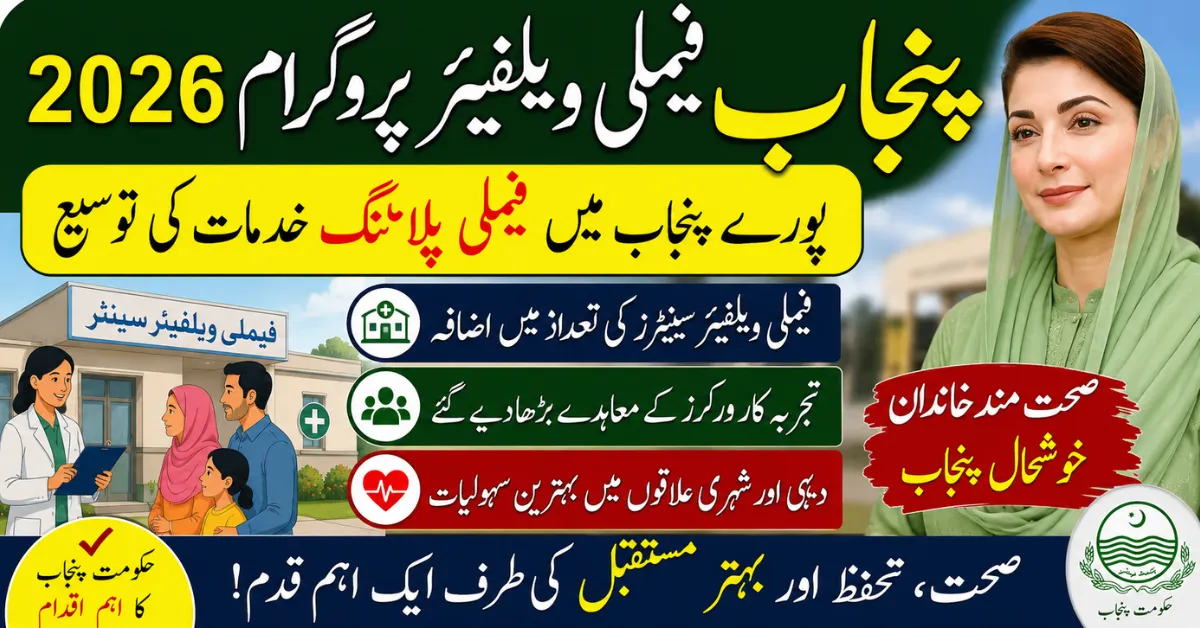
Last reviewed: 13 August 2026. Punjab’s Population Welfare Department publishes information about family-planning and mother-and-child welfare services. This independent guide explains what the department confirms, how readers can locate current information, and how to avoid misleading claims about public health services.
What the Population Welfare Department does
The official Punjab Population Welfare Department says the government is taking steps for the welfare and medical care of mothers and children and has allocated resources for medical and family-planning facilities. The department’s work is part of public-health and population-welfare administration, not a general-purpose cash-payment programme.
Depending on the facility and the current provincial arrangement, public services may include counselling, reproductive-health information, family-planning services, maternal and child-health awareness, and referrals. The exact service list, opening hours, staffing, and availability can vary by district and facility.
How to find current information
- Begin with the official Punjab Population Welfare Department website.
- Read the latest departmental notices rather than relying on a social-media post or an old blog headline.
- Confirm the facility name, district, opening hours, and contact route before travelling.
- Ask a qualified public-health worker what service is appropriate for your circumstances.
- Keep any appointment slip or official reference, but do not upload identity or medical documents to an unofficial website.
Family-planning information and informed choice
Family-planning decisions should be voluntary, informed, and discussed with a qualified provider. A public information article should not tell every reader to use one particular method or claim that a method is medically suitable for everyone. Providers can explain possible benefits, limitations, side effects, contraindications, and follow-up requirements.
Anyone with urgent symptoms, pregnancy-related concerns, complications, or a serious health problem should seek appropriate clinical care. This website does not diagnose conditions, prescribe treatment, or replace a doctor, nurse, midwife, or public-health professional.
Mother-and-child welfare information
Families may need different types of support at different stages, including antenatal care, postnatal advice, infant and child health information, nutrition guidance, immunisation information, and referral to a health facility. Because services and public notices change, readers should use the official department and local health authorities for current directions.
What this article does not claim
The department’s public information does not automatically establish a universal cash benefit, fixed stipend, guaranteed appointment, free medicine for every visitor, or province-wide service at every facility. Such claims should be made only when the responsible authority publishes the exact programme rules. A blog should not turn a general policy statement into a promise of individual assistance.
Privacy and scam prevention
- Do not publish a person’s CNIC, medical record, phone number, or pregnancy information in a comment.
- Do not pay an agent for guaranteed access to a public-health service.
- Be cautious of pages that use a government logo but request bank details, OTPs, or an advance processing fee.
- Use official departmental contact routes and licensed providers.
- Keep a record of the official page or notice used when arranging a visit.
Official source and responsibility
Use the Punjab Population Welfare Department as the starting point for current notices and service information. The department’s public pages may be updated without notice. Govt Schemes Secrets is an independent information website and is not a government health department.
Related guides
For other verified public-service information, see our support guide for widows and divorced women, disability-support guide, and youth skills guide.